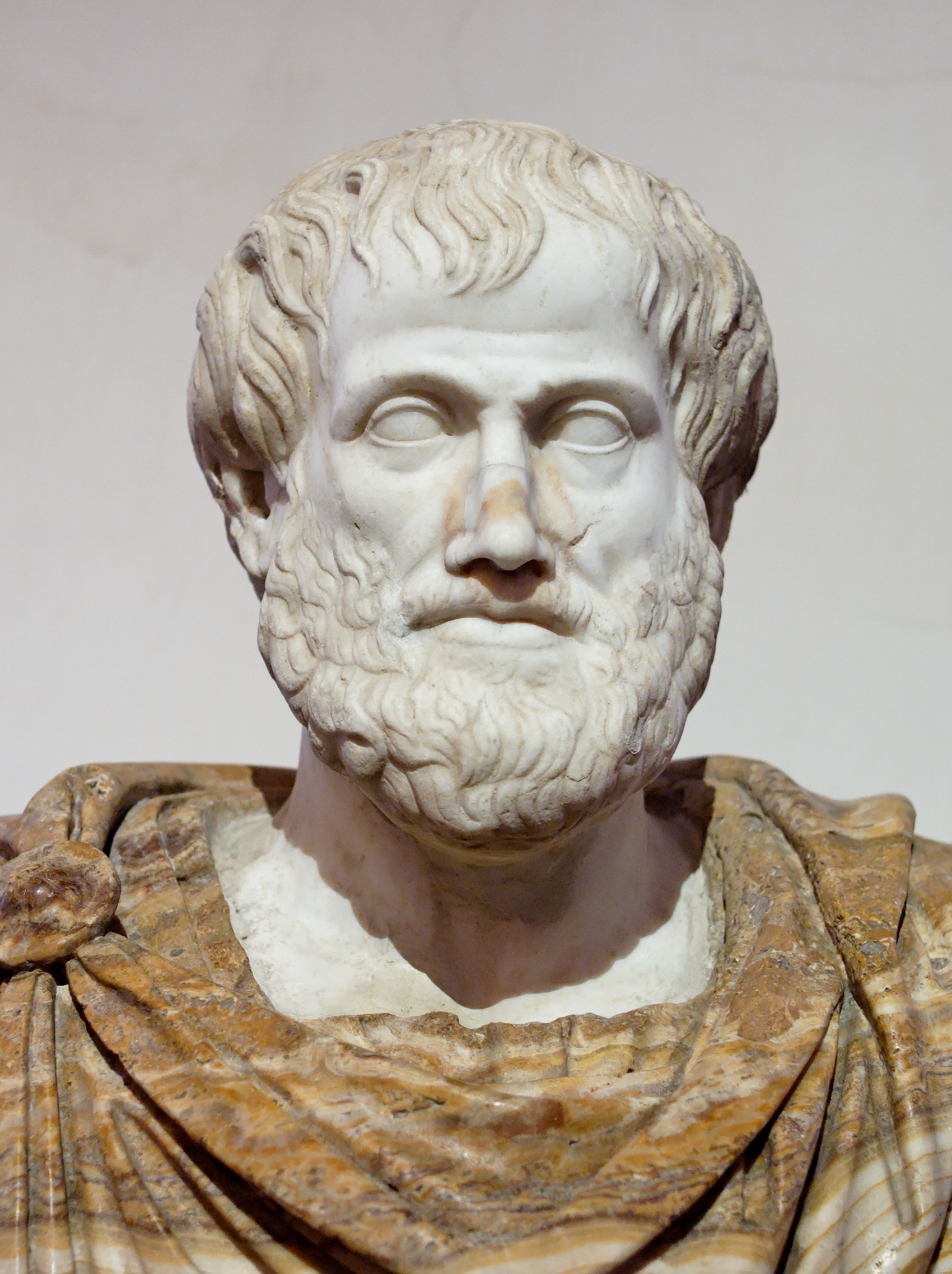
By Jastrow (2006), Public Domain

Aristotle (384–322 BC) was an ancient Greek philosopher and polymath; arguably the single most influential thinker in Western intellectual history. He was a student of Plato, founded his own school (the Lyceum in Athens), and later served as tutor to the young Alexander the Great.
What makes him remarkable is the sheer breadth of what he wrote about and systematised: logic, biology, physics, cosmology, metaphysics, ethics, politics, rhetoric, and literary theory. For centuries, “the Philosopher” was simply his title.
Why he matters
Formal logic. Aristotle invented it. His syllogism, the idea that valid conclusions follow necessarily from premises, was the foundation of reasoned argument for two millennia. He essentially gave Western thought its operating system.
Biology. He was the first systematic naturalist, classifying hundreds of animal species through direct observation. His insistence on looking at nature rather than just reasoning about it was genuinely novel.
Cosmology (and where he went wrong). He placed Earth at the centre of the universe, surrounded by rotating crystalline spheres carrying the planets and stars. Claudius Ptolemaeus later built his mathematical model on top of this framework. It was elegant, internally consistent, and wrong; but it dominated for nearly 1,500 years until Nicolaus Copernicus challenged it.
Ethics. His Nicomachean Ethics introduced virtue ethics: the good life (eudaimonia, often translated as flourishing or happiness) comes from cultivating character virtues — courage, honesty, practical wisdom — through habit and practice. It remains one of the most-read works in moral philosophy.
The transmission story. His original works were largely lost to medieval Europe and survived primarily through Arabic translations by Islamic scholars. They were re-introduced to the West around the 12th–13th century, triggering a massive intellectual upheaval and shaping scholastic theology (especially through Thomas Aquinas).
Key works
- Organon - the collected works on logic
- Physics and Metaphysics - nature, causation, substance
- Nicomachean Ethics - virtue and the good life
- Politics - comparative study of constitutions and governance
- De Anima - on the soul and perception
- History of Animals - systematic zoology
One thing to keep in mind
Much of his science turned out to be wrong (geocentrism, spontaneous generation, the four humours). But his method, systematic observation, classification, and reasoned argument, planted seeds that eventually grew into modern science. He was wrong in ways that were productive.