Aeron wanted to know if it had to do with the electron’s negative charge. Elias wanted to know if binary stars can drift so far apart that they break loose, and what happens when they get old. The best I could come up with was “a compass.”
Thursday night we were back at a lecture at Halley Observatory, and this time Iris, Aeron, and Elias all came along. After the inflationary universe and the northern lights, it was the stars’ turn: Pieter Vorstenbosch explained how we actually know anything about them.
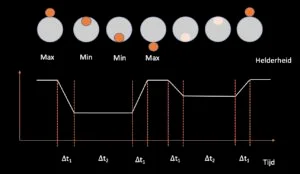
“To follow this lecture, you shouldn’t be afraid of a few formulas.” That’s what the website said, and Pieter repeated it right at the start: if you catch yourself thinking “I don’t get any of this,” just let them drift by. Good advice, because the story held up perfectly well without the math.
The common thread is simple: everything we know about stars comes from their light. Pieter took us through a century and a half of measuring, from the first stellar spectra to James Webb, and for every property of a star he showed how you tease it out of that light. The little lines in a spectrum turn out to be fingerprints: they tell you what a star is made of. Its color gives away how hot it is. Magnetic fields, scorching gas between galaxies, stars spinning so fast they nearly fly apart: it’s all there in the light, if you know where to look.
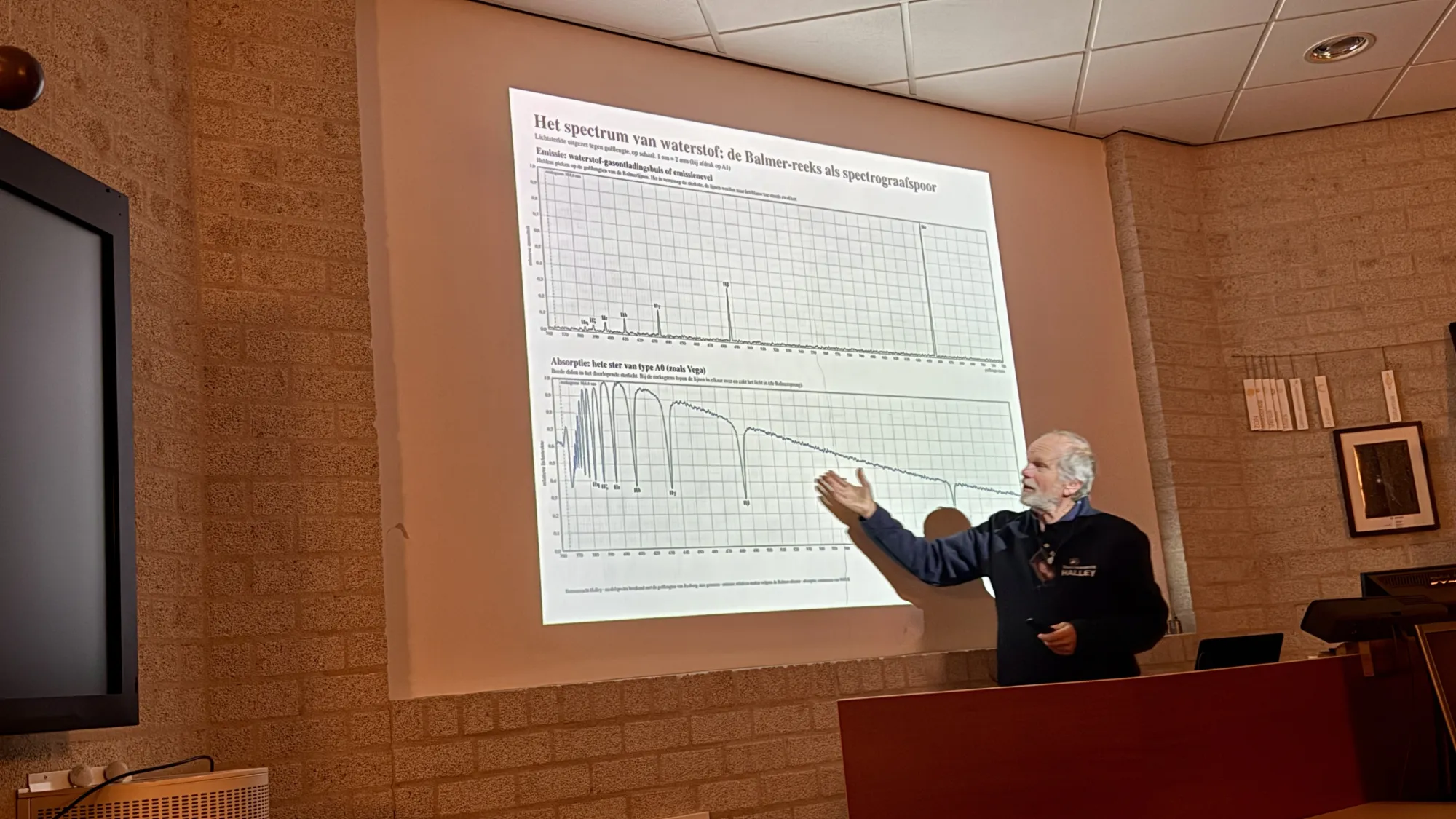
Pieter in front of the hydrogen spectrum.
Then came the math. How do you weigh a star you’ll never get on a scale? How do you measure the width of something that’s still just a dot in the best telescope? How far away is a place you can never go? Step by step, Pieter built it up, from the angle your own two eyes measure all day long to stars that serve as yardsticks in faraway galaxies. He wrapped up with exoplanets and what James Webb manages to pick up in their atmospheres. How much does a teaspoon of white dwarf weigh? I’m not telling; go ask Pieter.
It was a fantastic presentation, and very easy to follow, formulas or not. You could tell Pieter is an experienced speaker: a joke here, a fun fact there, and above all lots of examples. Time and again he’d explain a topic or theory first and then make it concrete: so what would that mean if…? Then came an example close to home, from the siren of a passing ambulance to a figure skater spinning a pirouette, so it landed every time. He never talked over anyone’s head and was really focused on his audience. I enjoyed it enormously, and so did the rest of us.
That compass was my answer to Pieter’s question about how you’d detect a magnetic field here on Earth. After that, the boys took over. Aeron dug deeper into the electron’s charge, and Elias was all in on binary stars.
When he asked whether they could break loose, the parent in me figured that wasn’t something you could explain in a sentence, and it would hold up the whole lecture besides. But Pieter took it seriously and gave an answer Elias could really work with: they lose their grip on each other and fly off. To top it off, after the lecture he actually demonstrated it, with an improvised setup of a little ball and a rail. Elias was seriously impressed, and he was still working on his notes today.
Those binary stars came back in the lecture itself, too. Pieter wanted to show an animation, but it refused to start and he had to exit his presentation to get it going (as anyone who’s ever used PowerPoint will recognize: sometimes it works, sometimes it doesn’t). Elias had already made up his mind: “Nope, that’s not very smart.” 😄 It was worth the wait. In the animation, two suns orbit each other, and you can adjust their mass, size, and brightness, along with the angle we see them from here on Earth. He did this live, talking us through it. Next to it runs a graph of what you’d measure from down here. Seeing the two side by side really made it click.
At the end, Pieter showed next year’s course lineup, from photographing the moon to smart telescopes. The lectures are held every fourth Thursday of the month and are listed on Halley’s website. According to Pieter, some high school physics will get you a long way, and if you ask a question, you’ll get a real answer. Either way, the four of us had a great time again!