Specs
| What | Data |
|---|---|
| Name | Jupiter |
| Class | Gas Giant |
| Planet number | 5 |
| Diameter | 142,984 km |
| Mass | 1.898 × 10²⁷ kg (318× Earth) |
| Distance from the Sun | 778 million km / 5.2 AU |
| Orbital period | 11.9 years |
| Rotation period | 9h 56m (fastest planet) |
| Known moons | 95 |
| Largest moon | Ganymede (larger than Mercury) |
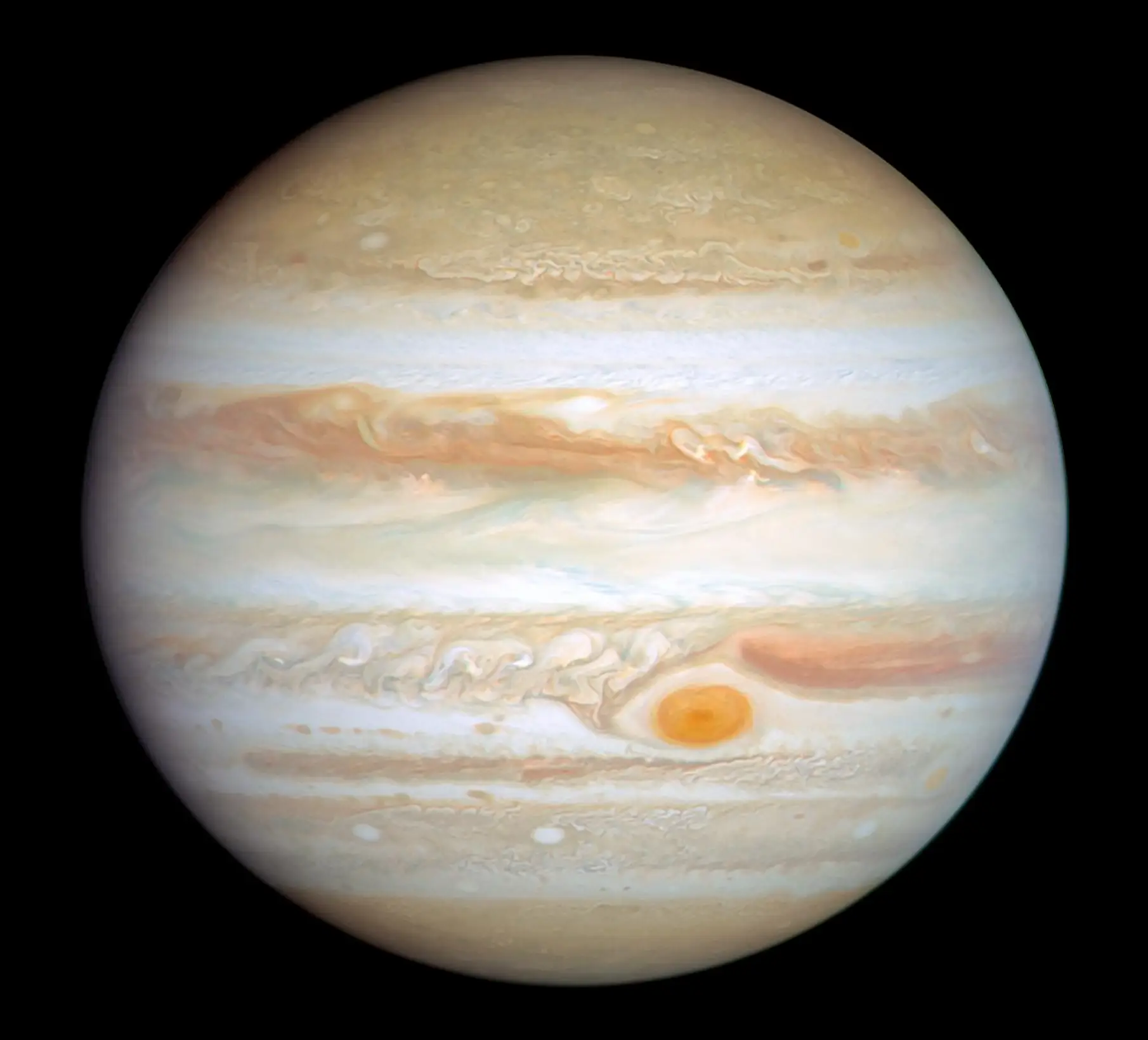
Great Red Spot
Jupiter’s most iconic feature is the Great Red Spot, a storm larger than Earth that has been raging for at least 350 years. It is slowly shrinking but remains one of the most striking phenomena in the solar system.
Moons
Jupiter has 95 known moons. The four largest, discovered by Galileo in 1610, are known as the Galilean moons:
- Io - the most volcanically active body in the solar system
- Europa - likely harbors a liquid water ocean beneath its icy crust
- Ganymede - the largest moon in the solar system, bigger than Mercury
- Callisto - heavily cratered, one of the oldest surfaces in the solar system
Role in the Solar System
Jupiter’s immense gravity acts as a shield for the inner solar system. It captures or deflects many comets and asteroids that would otherwise be on a collision course with Earth, earning it the nickname “the solar system’s vacuum cleaner.”