Specs
| What | Data |
|---|---|
| Name | Moon (Luna) |
| Class | Natural satellite |
| Parent planet | Earth |
| Diameter | 3,474 km |
| Mass | 7.342 × 10²² kg (1.2% of Earth) |
| Distance from Earth | 384,400 km (average) |
| Orbital period | 27.3 days |
| Rotation period | 27.3 days (tidally locked) |
| Surface gravity | 1.62 m/s² (1/6 of Earth) |
| Age | ~4.5 billion years |
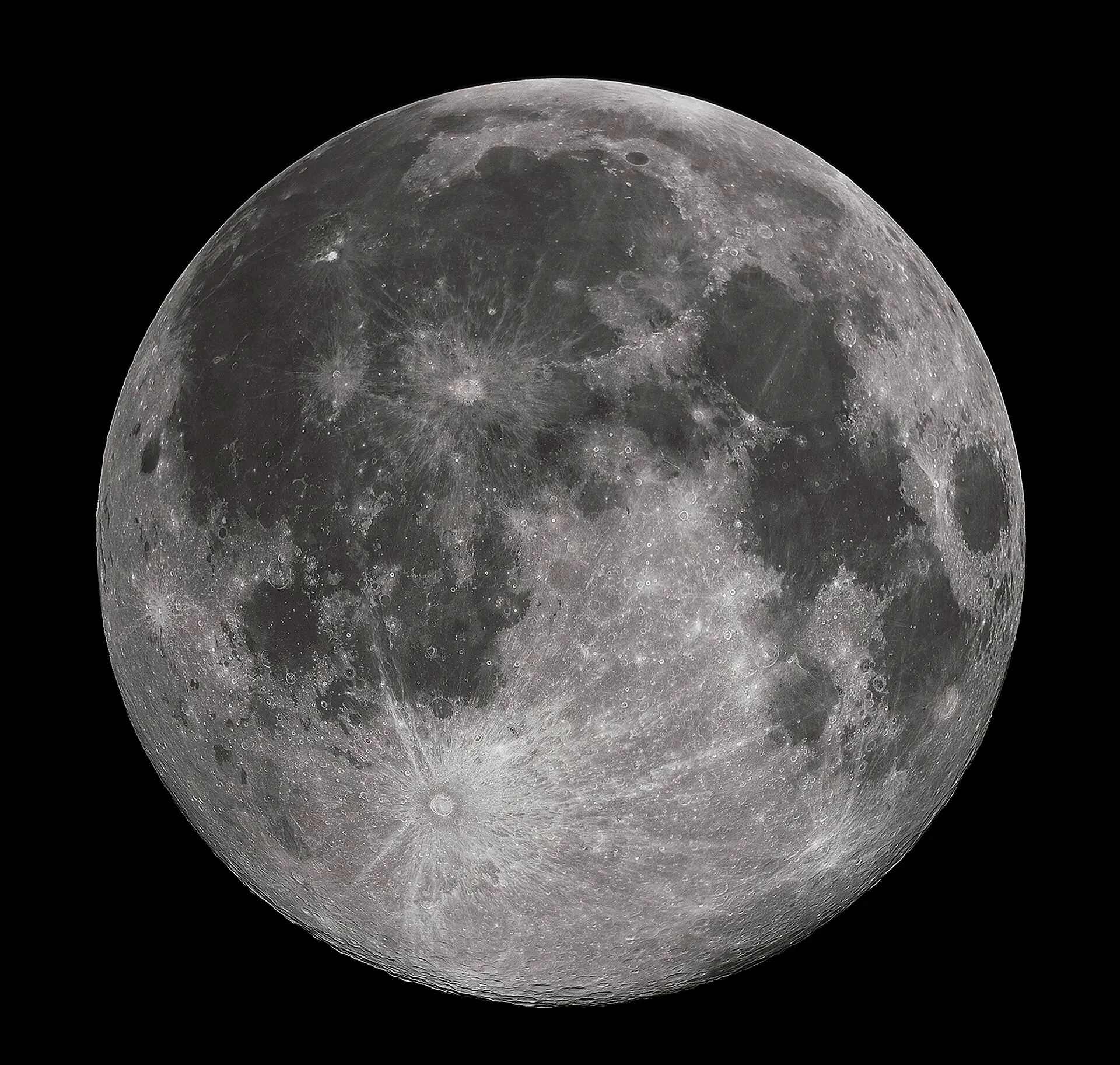
By Gregory H. Revera, CC BY-SA 3.0
Formation
The leading theory is the Giant Impact Hypothesis: shortly after the solar system formed, a Mars-sized body called Theia collided with the young Earth. The debris from that collision coalesced into the Moon. This explains why the Moon’s composition closely matches Earth’s mantle.
Surface
The Moon’s surface is divided into two main types:
- Maria - dark, flat plains formed by ancient volcanic lava flows. The largest is the Oceanus Procellarum. These are what give the Moon its “face.”
- Highlands - lighter, heavily cratered terrain that is older than the maria. Most craters were formed during the Late Heavy Bombardment ~4 billion years ago.
Because the Moon has no atmosphere, craters are preserved for billions of years with no erosion to wear them down.
Tidal Influence
The Moon’s gravity is the primary driver of Earth’s ocean tides. It also stabilizes Earth’s axial tilt at around 23.5°, which is what gives us our seasons. Without the Moon, Earth’s tilt would vary chaotically, making the climate far less stable.
Exploration
The Moon is the only celestial body beyond Earth that humans have visited. Key milestones:
- 1959 - Luna 2 (Soviet Union) becomes the first spacecraft to reach the Moon
- 1969 - Apollo 11 lands the first humans on the Moon (Neil Armstrong and Buzz Aldrin)
- 1969-1972 - Six Apollo missions land a total of 12 astronauts on the lunar surface
- 2024- - NASA’s Artemis program aims to return humans to the Moon