This week my kids have the May holiday and are free from school. I’ve decided to use this freedom to sign me and my oldest (just turned 10) up for the lecture “Stairway to Heaven - de kosmische afstandsladder” or “Stairway to Heaven – The Cosmic Distance Ladder” at Halley Observatory. The lecture would be given by Sander de Jong.
I did so on a whim, as the lecture topic referred to numbers so big that they might just as well describe the amount of money Dagobert Duck (Scrooge McDuck) has. This led me to believe this would be a very child-friendly lecture, although late (after his bed-time).
On the day itself I read into the rest of the topic:
“How far away are those stars, really?
Astronomers talk about distances of millions and even billions of light-years. For most people, that feels a bit like when Scrooge McDuck says he has “72 fantastillion in his Money Bin” — a number so large it has stopped meaning anything at all.
With cosmic distances, it’s often just the same: enormous, but impossible to picture.
In this lecture, we take a journey through the history of astronomy and build the cosmic distance ladder step by step. From the first measurements of the distance to the Moon and the Sun, through variable stars and supernovae, all the way to the scale of the entire universe. Every rung of the ladder changed how we see the world. From a small cosmos centered on the Earth… to a universe full of galaxies stretching billions of light-years across.
How do we actually know how far the universe reaches? And how do astronomers measure distances so vast that “fantastillion” almost seems like a reasonable unit?
Find out in Stairway to Heaven – The Cosmic Distance Ladder.”
Hmm, clearly I had made a mistake. This was going to be above the level and understanding of Aeron, this was going to be a tough session… I promised him though, and figured it might still be worthwhile: a late night out together, and he might get something out of it even if not everything landed.
He often seems to have broad interests and the lecture isn’t endless.
So, I’ve decided to go through with it.
And that, happily, seemed to be a perfect decision. While the lecture definitely was mature and touched on some complex topics and a lot of history, Aeron really loved it! He had a little notebook and was scribbling away. When I checked in during the lecture: “Do you understand this?”, “Are you doing okay?”, he hushed me to silence: “Shht dad!! I’m trying to listen!”.
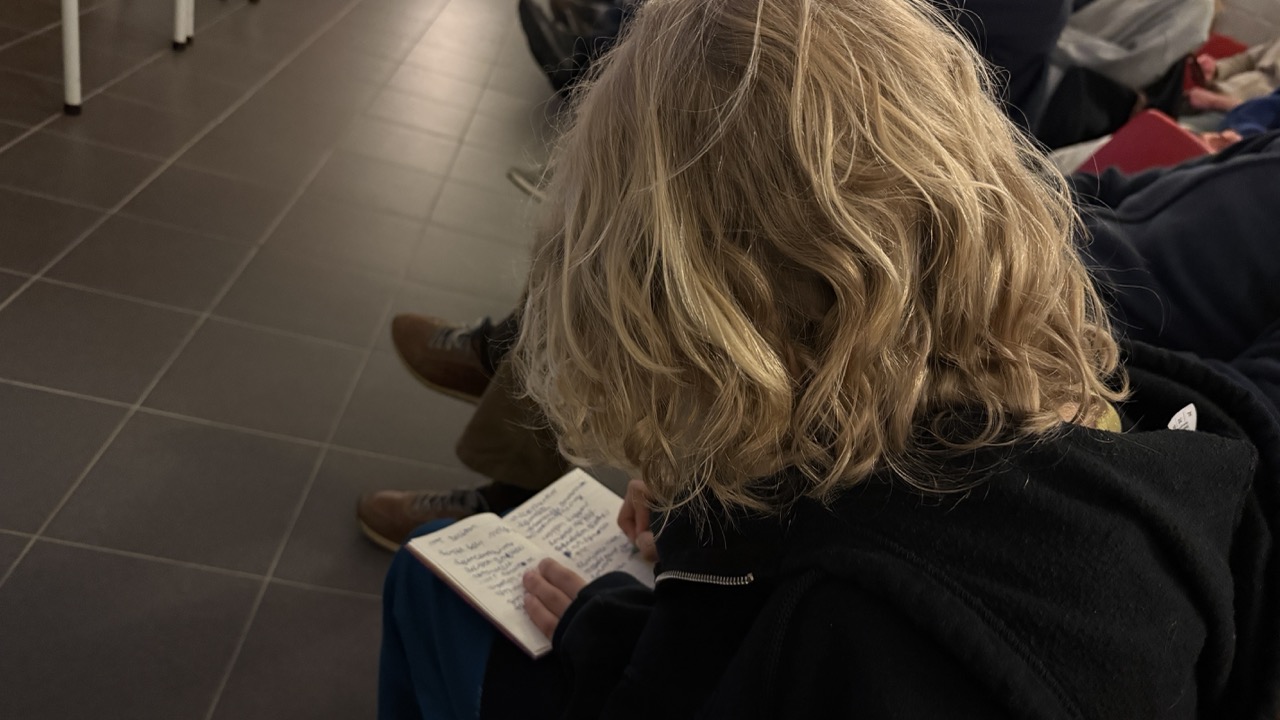
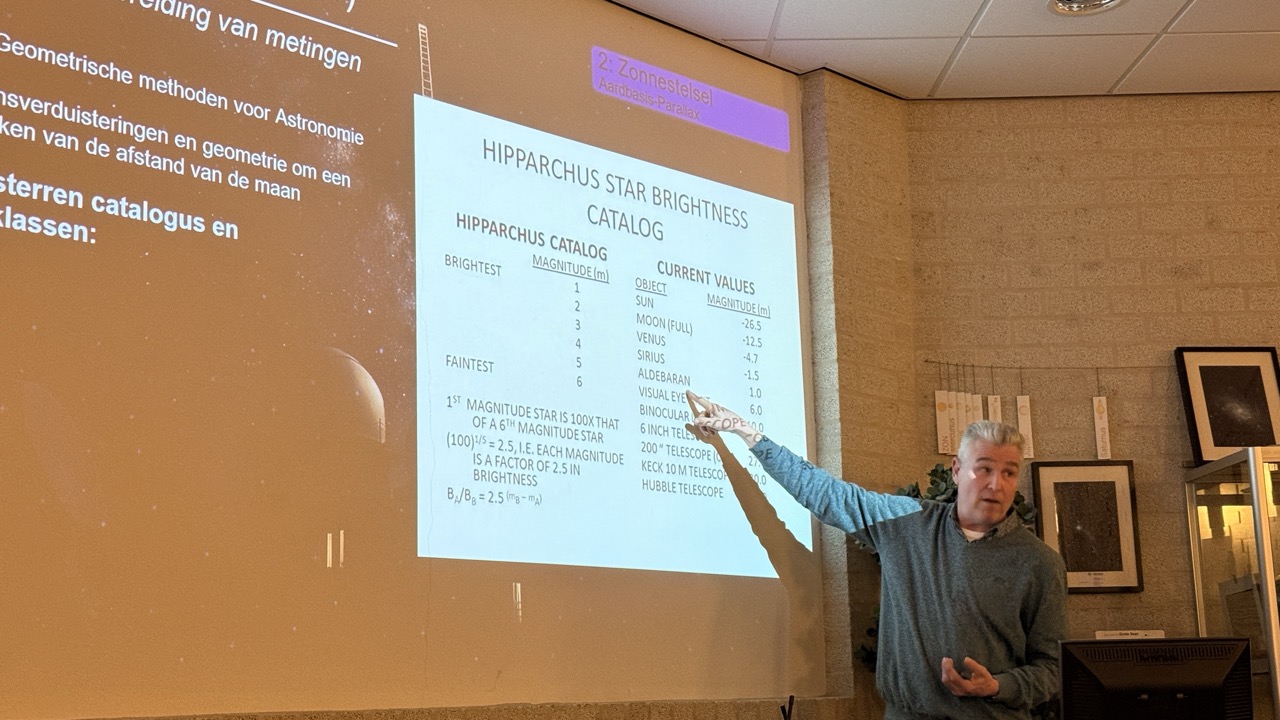
Sander gave a great lecture. He started with a small quiz, that really showed how little grasp we humans have of big numbers. Then he really went into the history and ways we started to understand and measure our universe. He did an amazing job of showing how the great minds of the past made a shift in the way we understand things, how bizarrely brilliant and diligent they had to be to come to their insights and the risks that sometimes accompanied those shifts in thought, as they were not always received well in their time.
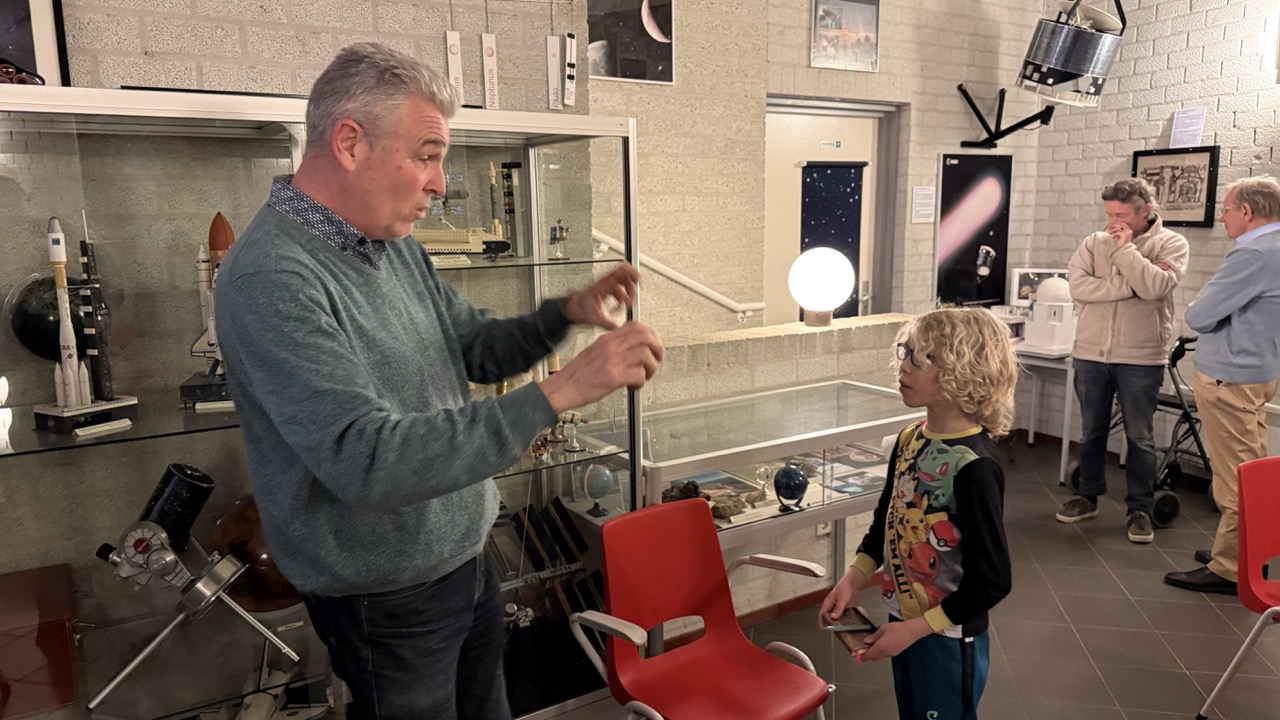
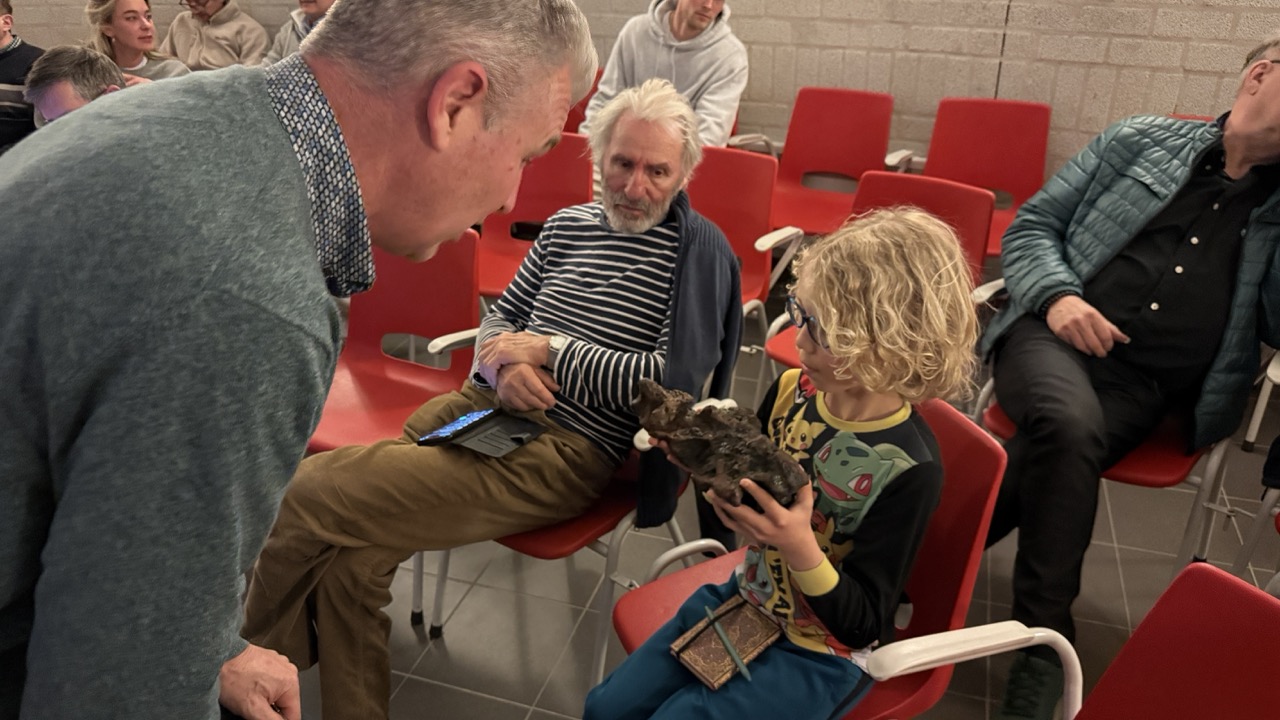
When the coffee break in the lecture came, Aeron jumped on Sander with questions. Sander really took the time to answer them and even let Aeron touch and weigh a real meteor in his hands.
He walked us through a number of great names and their roles: Aristotle, Eratosthenes, Hipparchus, Claudius Ptolemaeus, Nicolaus Copernicus, Tycho Brahe, Galileo Galilei, Isaac Newton, Friedrich Bessel, Christian Doppler, William Huggins, Harlow Shapley, Henrietta Swan Leavitt, Annie Jump Cannon, Williamina Fleming, Subrahmanyan Chandrasekhar, Mark M. Phillips, Saul Perlmutter, Brian P. Schmidt, Adam G. Riess, Georges Lemaître, Edwin Hubble.
He talked about big discoveries, space missions and endeavors that made a big lasting impact on our understanding and the way we view and understand space. As he took the scale and distance of the universe, creating a ladder outwards, it was marvelous to see space expand before us.
Afterwards he invited us up to the observatory where we watched the Moon and Jupiter through the telescope. We watched the craters of the moon and the clouds (lines) of Jupiter in some detail and Aeron (as well as me) were quite blown away by it all.
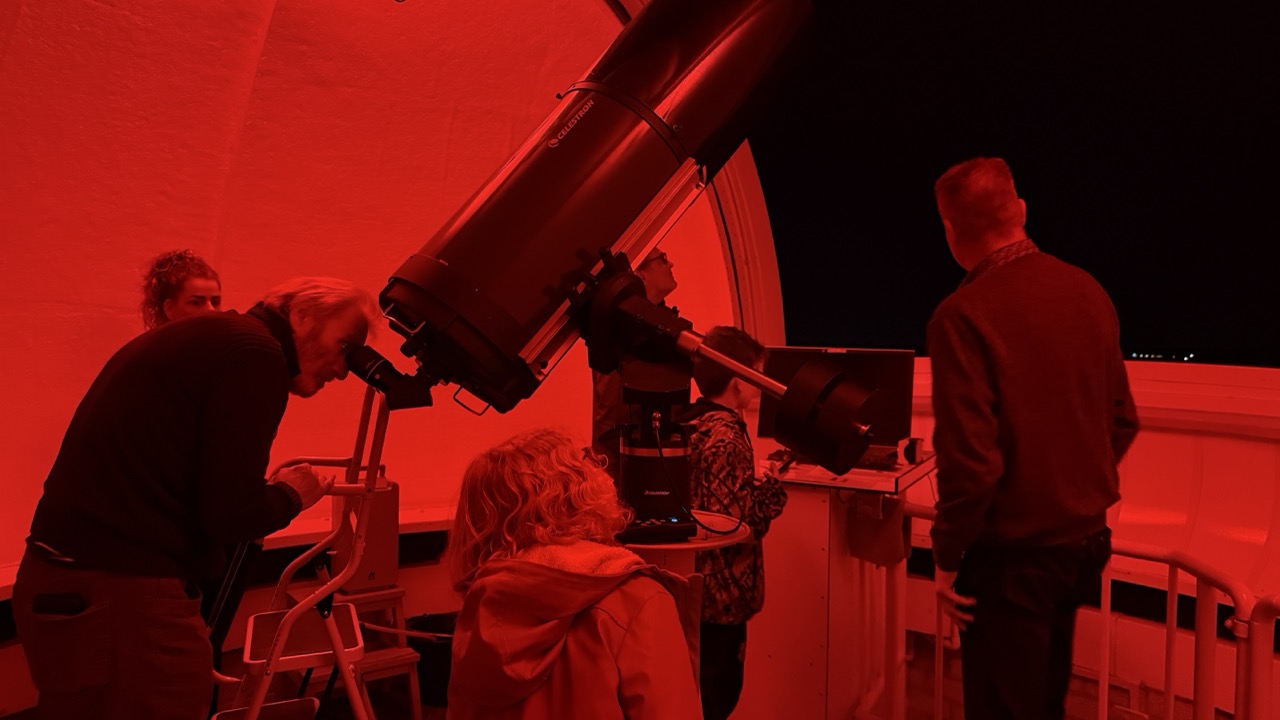
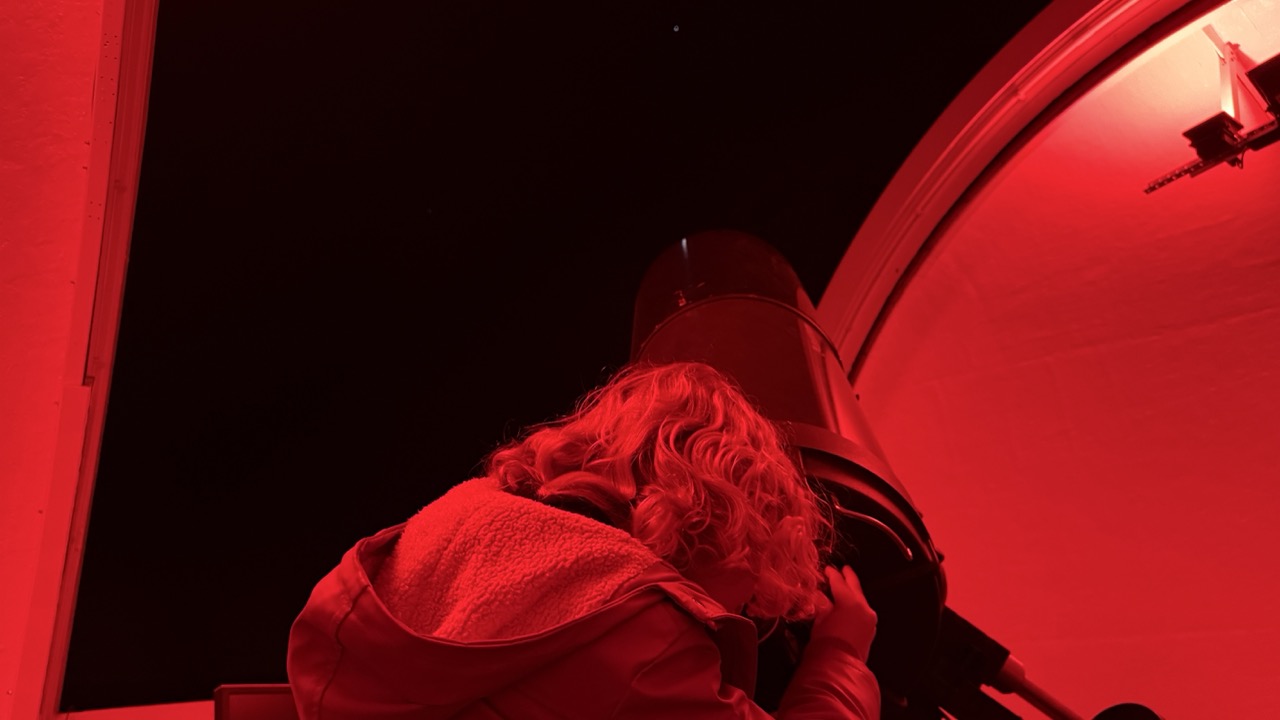
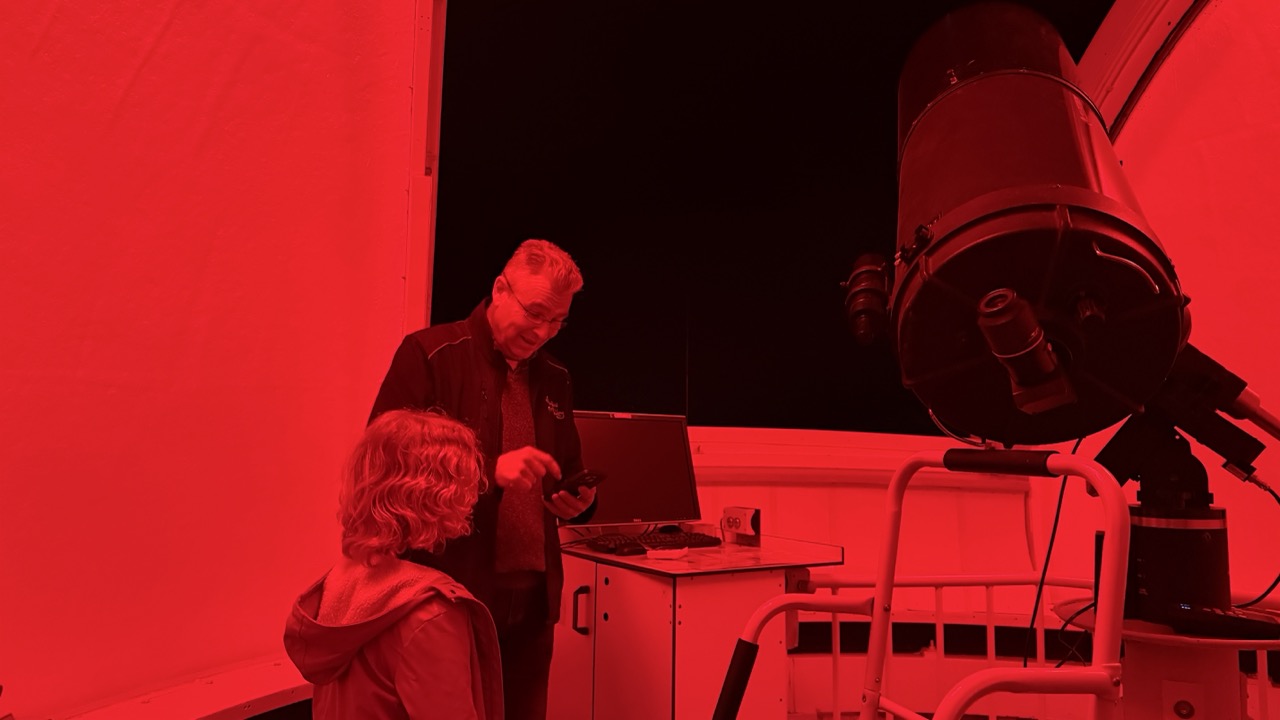
As we returned home, somewhere near 23:00 hours, Aeron couldn’t stop talking about it all on the back of my bike. This lecture really awoke something in Aeron (and rekindled it for me), we’ll be doing this a whole lot more! We already enlisted for the next lecture there!